
Sarcoptes scabiei: Mite, Eggs, and Scybala in Skin Scrapings
Original bench-card visuals for reading a skin scraping for scabies: the round eight-legged Sarcoptes scabiei mite, its oval eggs, and brown fecal pellets (scybala).
Scabies skin scraping: mite, eggs, and scybala
Sarcoptes scabiei is a mite, so the adult has 8 legs. The adult female is about 0.3-0.45 mm, round to oval, with short stubby legs and spines on the back. Eggs are oval and about 0.10-0.15 mm. Scybala are small golden-brown fecal...
About 0.3-0.45 mm for the adult female. Round, sac-like body with four pairs of short legs, two pairs toward the front and two toward the back. Spines and ridges cov...
Eggs are oval, thin-shelled, and about 0.10-0.15 mm. Scybala are smaller, irregular, golden-brown pellets, often seen in groups. Either one is enough for a positive...
What this looks like down the scope
The board above is drawn to isolate the pattern. These are clinical images of the same stages, published as you see them, so you can find the pattern with everything else still in the field.
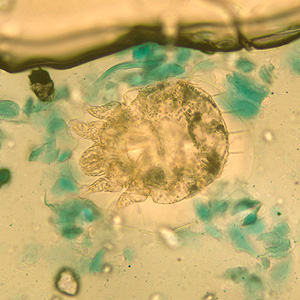
Skin scraping, lactophenol cotton blue. Round body, short stubby legs, no wings and no segmented abdomen - a mite, not an insect.
Source: CDC / DPDx | Public domain (U.S. federal government work) | Original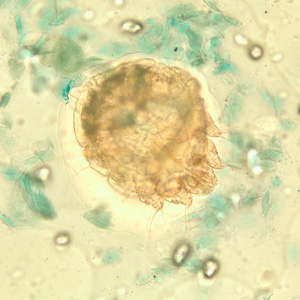
Closer in. One mite in a scraping is a positive; the yield is low, so a negative scraping never rules scabies out.
Source: CDC / DPDx | Public domain (U.S. federal government work) | Original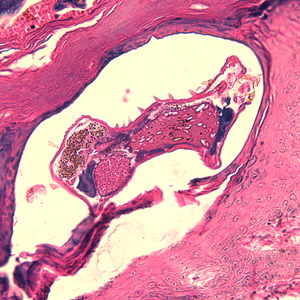
Skin biopsy, H&E, with the mite sitting inside its burrow in the stratum corneum. This is how it is found when the scraping was negative.
Source: CDC / DPDx | Public domain (U.S. federal government work) | OriginalShown as published and free of charge from the source above, which does not endorse Learn Microbes. Full image credits
Skin scraping anchors
| Visual clue | Meaning | Student shorthand |
|---|---|---|
| Round mite with 8 short legs | Sarcoptes scabiei adult | Mites are arachnids; insects such as lice have 6 legs |
| Oval thin-shelled eggs in skin debris | Scabies eggs | Diagnostic even without a mite |
| Golden-brown pellets in clusters | Scybala (mite feces) | Diagnostic; mineral oil preserves them |
| Elongated worm-like mite | Demodex, not Sarcoptes | Follicle mite; different clinical meaning |
| Very many mites in thick crusts | Crusted (Norwegian) scabies | Highly contagious; seen in immunocompromised or debilitated patients |
Scabies scraping readout
| Pattern | What to call it | How to think about it |
|---|---|---|
| Mite, eggs, or scybala seen | Positive for Sarcoptes scabiei | Any one of the three is sufficient |
| Elongated follicle mite only | Demodex species | Report per SOP; not scabies |
| Skin cells and debris only | No mites, eggs, or scybala seen | Does not exclude scabies; recollection may be needed |
- Adult Sarcoptes has a round body and 8 short legs; larvae have 6.
- Mites, eggs, or scybala each confirm the diagnosis.
- Mineral oil mounts are preferred, and a single negative scraping has limited value.
Round 8-legged mite, oval eggs, or brown scybala in a scraping = scabies.
New bench cards and study tools are added regularly. Join the Lab List to hear about new cards and have a say in what gets built next.