
Malassezia furfur: Spaghetti and Meatballs on KOH
Original bench-card visuals for recognizing Malassezia in skin scrapings and culture: short curved hyphae with clusters of round yeast cells on a KOH preparation, and small bottle-shaped yeast with a collarette.
Malassezia: short hyphae with round yeast clusters, and bottle-shaped budding cells
Malassezia is a lipid-loving yeast that lives on normal skin and causes pityriasis (tinea) versicolor. In skin scales cleared with KOH, the classic pattern is short, curved hyphae mixed with clusters of round yeast cells, describe...
Short, stubby, curved hyphae lie among grape-like clusters of round, thick-walled yeast cells. Both forms together make the diagnosis from a direct preparation. Calc...
Small yeast cells about 3-8 um. Each buds repeatedly from the same end through a broad base, leaving a small collar, so the cell looks like a bottle or bowling pin....
What this looks like down the scope
The board above is drawn to isolate the pattern. These are clinical images of the same stages, published as you see them, so you can find the pattern with everything else still in the field.
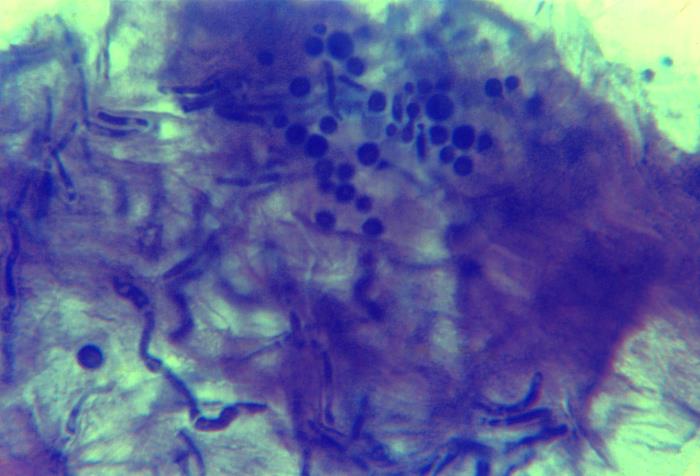
A skin scraping at 970x. Round yeast cells in clusters with short curved hyphal pieces scattered between them - the spaghetti and meatballs pattern. Both elements together make the call; neither alone does.
Source: CDC / PHIL - Dr. Lucille K. Georg | Public domain (U.S. federal government work) | OriginalShown as published and free of charge from the source above, which does not endorse Learn Microbes. Full image credits
Malassezia anchors
| Visual clue | Meaning | Student shorthand |
|---|---|---|
| Short hyphae plus round yeast clusters in skin scales | Malassezia, pityriasis versicolor pattern | Direct exam is usually enough; culture is rarely needed |
| Bottle-shaped yeast with a collarette | Malassezia yeast form | Budding from one pole on a broad base |
| No growth on routine fungal media | Lipid requirement not met | Overlay the agar with sterile olive oil |
| Yeast in a blood culture from an infant on lipid infusion | Consider Malassezia | Subculture needs lipid supplementation |
| Yellow-gold fluorescence of skin under a Wood lamp | Supports pityriasis versicolor | A clinical clue, not a lab identification |
Malassezia study readout
| Pattern | What to call it | How to think about it |
|---|---|---|
| Short hyphae and yeast clusters on KOH of skin scales | Consistent with Malassezia | Report the direct exam finding per SOP |
| Long branching septate hyphae, no yeast clusters | Dermatophyte pattern | Culture on dermatophyte media |
| Small bottle-shaped yeast growing only with oil overlay | Lipid-dependent Malassezia | Report per the lab's identification method |
- Spaghetti and meatballs on KOH is the classic direct exam picture.
- The yeast is bottle shaped with a collarette and a broad-based bud.
- Add lipid, such as an olive oil overlay, when culture is required.
Short hyphae + round yeast clusters on KOH = Malassezia. Needs lipid to grow.
New bench cards and study tools are added regularly. Join the Lab List to hear about new cards and have a say in what gets built next.