
Human Lice: Pediculus humanus and Phthirus pubis
Original comparison visuals for identifying human lice submitted to the lab: the elongated head or body louse, the broad crab louse with enlarged claws, and a nit cemented to a hair shaft.
Lice: elongated Pediculus, crab-shaped Phthirus, and a nit on hair
Lice are insects, so adults have 6 legs. Pediculus humanus (head and body lice) is elongated, about 2-4 mm, with legs of similar size. Phthirus pubis (crab louse) is shorter and wider, about 1-2 mm, with large claws on the second...
About 2-4 mm. The body is longer than it is wide, with a distinct head, thorax, and segmented abdomen. All three pairs of legs are similar in size and end in claws....
About 1-2 mm. The body is nearly as wide as it is long, which gives the crab appearance. The second and third pairs of legs carry large, heavy claws for gripping coa...
An oval egg about 0.8 mm long, attached at an angle to the hair by a cement sheath, with a cap (operculum) at the free end. It does not slide along the hair. Hair ca...
What this looks like down the scope
The board above is drawn to isolate the pattern. These are clinical images of the same stages, published as you see them, so you can find the pattern with everything else still in the field.
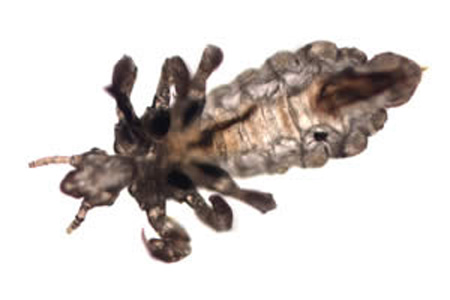
Pediculus: long and narrow, roughly three times as long as wide, with six similar legs. Head and body lice look the same - the site decides which it is.
Source: CDC / DPDx | Public domain (U.S. federal government work) | Original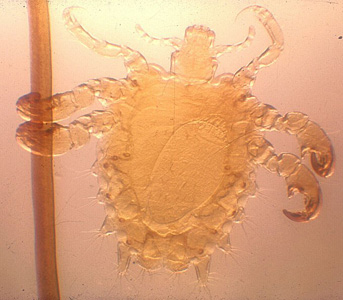
Phthirus: short, broad and crab-like, almost as wide as it is long. The back two pairs of legs end in heavy claws built to grip a thick hair.
Source: CDC / DPDx | Public domain (U.S. federal government work) | Original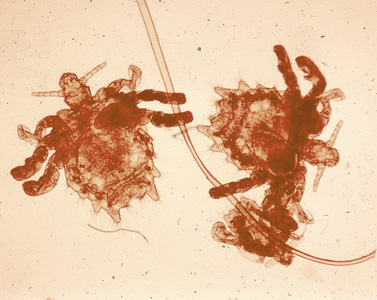
Three of them holding a hair. Seen like this the shape difference needs no measuring, and the claws make obvious sense.
Source: CDC / DPDx | Public domain (U.S. federal government work) | Original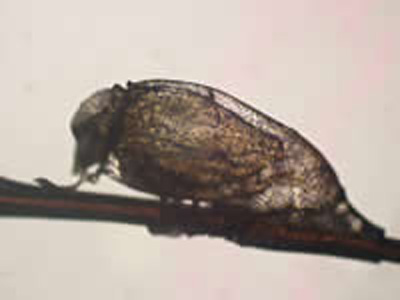
A nit cemented to the hair shaft, with the nymph coming out of the lid. Nits within 6 mm of the scalp suggest active infestation; further out they are old.
Source: CDC / DPDx | Public domain (U.S. federal government work) | OriginalShown as published and free of charge from the source above, which does not endorse Learn Microbes. Full image credits
Louse identification anchors
| Visual clue | Meaning | Student shorthand |
|---|---|---|
| 6 legs, wingless, flattened top to bottom | Louse (insect) | Mites and ticks have 8 legs as adults |
| Elongated body, legs similar in size | Pediculus humanus | Head louse or body louse by site |
| Wide body, large claws on legs 2 and 3 | Phthirus pubis | Crab louse |
| Oval capped egg fixed to hair | Nit | Empty nits remain after hatching |
| Flake that slides freely along the hair | Hair cast or dandruff | Not a nit |
Louse study readout
| Pattern | What to call it | How to think about it |
|---|---|---|
| Elongated louse from scalp hair | Pediculus humanus capitis | Head louse |
| Elongated louse from clothing seams | Pediculus humanus humanus | Body louse; vector of several bacterial diseases |
| Broad louse with large claws from pubic hair | Phthirus pubis | Crab louse |
- Lice have 6 legs; body shape and claw size separate the two genera.
- A true nit is cemented to the hair and has a cap.
- Body lice are the vectors for epidemic typhus, trench fever, and louse-borne relapsing fever.
Long body = Pediculus. Crab body with big claws = Phthirus. Stuck to the hair with a cap = nit.
New bench cards and study tools are added regularly. Join the Lab List to hear about new cards and have a say in what gets built next.