
Arthroconidia Comparison: Coccidioides, Geotrichum, and Trichosporon
Original comparison visuals for three fungi that form arthroconidia: Coccidioides with alternating barrel-shaped cells, Geotrichum with consecutive rectangular cells, and Trichosporon with arthroconidia plus budding blastoconidia.
Arthroconidia: alternating, consecutive, or mixed with budding cells
Arthroconidia form when a hypha breaks into individual cells. Three patterns matter. Coccidioides: barrel-shaped arthroconidia alternate with empty cells. Geotrichum: rectangular arthroconidia in a continuous row with no empty cel...
Thick-walled, barrel-shaped arthroconidia alternate with thin, empty disjunctor cells. When the chain breaks, pieces of the empty cell wall stay attached to each end...
Hyphae break into rectangular arthroconidia one after another with no empty cells between. A germ tube growing from one corner gives a hockey-stick shape. No blastoc...
Rectangular arthroconidia are present together with budding blastoconidia, and pseudohyphae may be seen. The mixture separates it from Geotrichum. Urease positive.
What this looks like down the scope
The board above is drawn to isolate the pattern. These are clinical images of the same stages, published as you see them, so you can find the pattern with everything else still in the field.
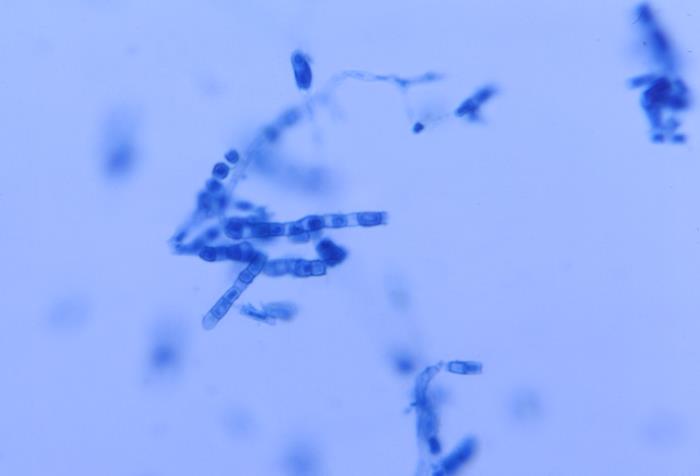
Barrel-shaped, and crucially alternating: every other cell has collapsed and emptied, leaving gaps along the chain. That alternation is unique here, and this is the one of the three that is a biosafety emergency.
Source: CDC / PHIL - Dr. Lucille K. Georg | Public domain (U.S. federal government work) | Original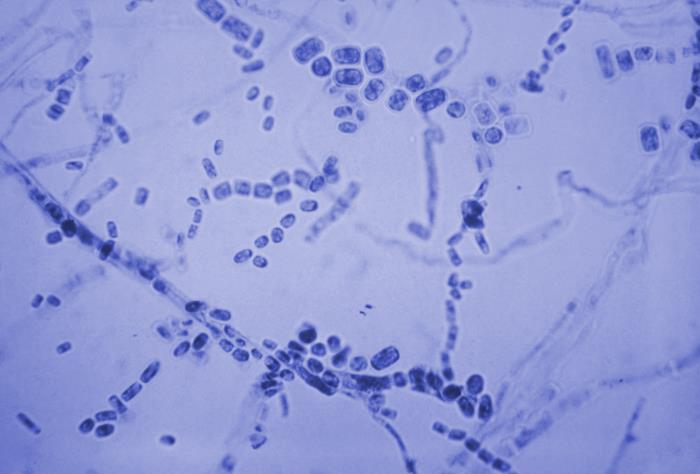
Rectangular and consecutive - every cell in the chain is present, none collapsed, and nothing buds off anywhere. Square corners end to end with no gaps.
Source: CDC / PHIL - Dr. Lucille K. Georg | Public domain (U.S. federal government work) | Original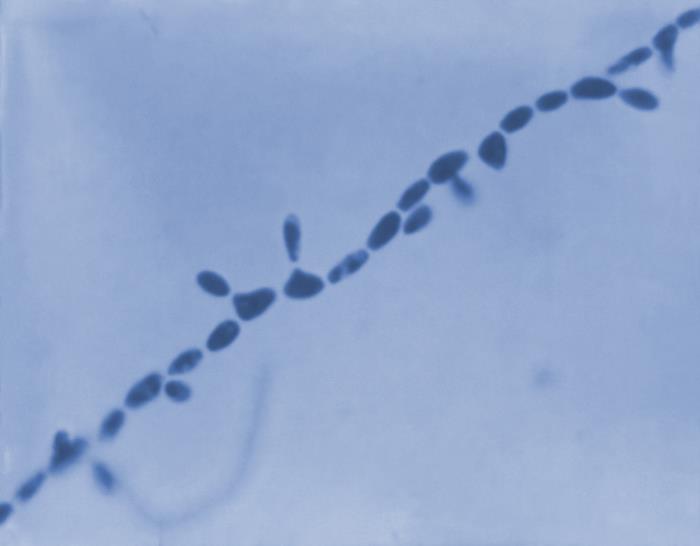
Rectangular arthroconidia like Geotrichum, but look for buds as well - round blastoconidia budding off the same filament. Doing both is what separates it from Geotrichum.
Source: CDC / PHIL - Dr. William Kaplan | Public domain (U.S. federal government work) | OriginalShown as published and free of charge from the source above, which does not endorse Learn Microbes. Full image credits
Arthroconidia anchors
| Visual clue | Meaning | Student shorthand |
|---|---|---|
| Alternating arthroconidia with empty cells | Coccidioides pattern | Stop open-bench work; use the biosafety level required by your lab |
| Consecutive rectangular arthroconidia only | Geotrichum | Hockey-stick germination from a corner |
| Arthroconidia plus budding cells | Trichosporon | Urease positive |
| Urease result | Trichosporon positive, Geotrichum negative | Useful when buds are hard to find |
| White mold, alternating arthroconidia, no travel history given | Still handle as possible Coccidioides | Malbranchea is a look-alike but is excluded by confirmatory testing |
Arthroconidia study readout
| Pattern | What to call it | How to think about it |
|---|---|---|
| Alternating barrel-shaped arthroconidia in a white mold | Presumptive Coccidioides | Containment, confirmatory testing, and notification per policy |
| Consecutive arthroconidia, no blastoconidia, urease negative | Geotrichum | Yeast-like colony; often of limited clinical significance |
| Arthroconidia with blastoconidia, urease positive | Trichosporon | Can cause invasive infection in immunocompromised patients |
- Alternating arthroconidia with empty cells between them means think Coccidioides and think safety.
- Geotrichum has consecutive arthroconidia and no buds.
- Trichosporon has both arthroconidia and blastoconidia and is urease positive.
Alternating = Coccidioides. Consecutive only = Geotrichum. Consecutive plus buds = Trichosporon.
New bench cards and study tools are added regularly. Join the Lab List to hear about new cards and have a say in what gets built next.